The Big Issue Magazine
UX Research
The Big Issue Magazine exists to empower people experiencing homelessness or disadvantage by offering legitimate income through the sale of street magazines. The focus of this UX research study is to explore how a digital edition can maintain.
The Big Issue’s social impact and vendor income—adapting to new reader habits, digital technologies, and consumer expectations—all while keeping vendors at the core of the model

Project Brief & Scope
Key Research Question:
How can The Big Issue introduce a digital edition that preserves vendor involvement and income, ensuring continued social impact, amid shifts toward digital media consumption?
-
The project is strictly focused on user research—no design or prototyping.
-
The outcome is to deliver actionable user insights that will guide future digital solutions for The Big Issue, ensuring the essential role and benefit of vendors are not lost in the transition.
Research Methods & Approach
A multi-method research approach underpins the study:
Online Surveys: Used to collect quantitative data on awareness, digital readiness, reading preferences, perceptions of value, and pricing expectations among a diverse sample of potential and existing readers.
One-on-one Interviews: Conducted to gather qualitative insights on motivations, purchase behaviors, emotional drivers/barriers, attitudes to social impact, and responses to the prospect of a digital edition. Semi-structured interview guides facilitate exploration of nuanced user perspectives.
Desk Research & Peer Benchmarking: Review of global street paper digital models (e.g., Big Issue UK, Faktum Sweden, Street Roots USA) and mainstream digital magazine offerings, extracting best practices and lessons for vendor-centric digital sales.



Target Audience Definition
The research targets three core user groups:
-
Current Readers: Buyers of the physical magazine, often encountered in urban environments, who may have habitual or emotional connections to vendors.
-
Potential/Occasional Readers: Digitally-savvy, socially-aware individuals open to supporting social causes, but not regular buyers—typically urban dwellers with busy lifestyles and digital payment preferences.
-
Vendors: Where feasible, input is gathered directly from vendors, whose involvement, needs, and digital readiness are pivotal for a successful solution.
Demographic diversity across age, gender, and geography is prioritized to reflect key segments in the market and user base.

Interview Techniques
-
Semi-Structured Interviews: Examine participants’ reading/buying behaviors, payment preferences, prior experiences with street magazines, and perceived barriers—such as lack of cash, unclear impact, or difficulty finding a vendor.
-
Empathy Mapping: Captures what users say, think, do, and feel about the magazine, particularly focusing on the value of vendor interaction, urgency or guilt when passing vendors, and attitudes to digital alternatives
User Persona
Cathy, a married professional in her mid-30s with strong digital skills and online shopping habits, is an ideal user persona for The Big Issue’s digital edition:
-
Matches Target Demographic: Survey results show most prospective readers are urban, female, 26–45, and digitally savvy—traits embodied by Cathy.
-
Supports Social Impact: Highly educated, employed women are statistically most inclined to back causes like homelessness; Cathy’s background reflects this.
-
Digital Preferences: Cathys are likely to read digitally for convenience, sustainability, and instant access, and value easy payment methods (Apple Pay, Google Pay).
-
Tech Comfort: She’s comfortable with apps, digital payments, and mobile platforms, which are necessary for adopting a digital magazine.
-
Brand Advocacy: Cathy tends to share experiences with friends, supporting word-of-mouth growth.
-
Fits Business Goals: Targeting users like Cathy helps expand the audience, increase digital adoption, and drive impact for both vendors and readers.
Cathy’s persona closely mirrors the most engaged and willing digital audience found in research, making her ideal to guide product and marketing strategy for The Big Issue’s digital edition.
_Page_07.jpg)
User Journey Mapping
-
Awareness: Notices vendor at a busy location or through social media/word-of-mouth.
-
Consideration: Wants to help but is often rushed, may lack cash, or feels uncertain about what to do.
-
Action: Might stop and purchase, or scan for digital options if clearly explained and easy to enact.
-
Reflection: Feels good about making a difference, but if the process was unclear or inconvenient, may feel regret or frustration.
-
Loyalty/Retention: Would repeat purchase or subscribe if it’s easy, transparent, and continues to support the vendor directly
.webp)
Interview Based Pain Points & Opportunities
Pain Points
-
Not knowing if a vendor accepts cashless or digital payment
-
Unclear if buying digital truly benefits a vendor
-
Time pressure or awkwardness interacting with street vendors
-
Reluctance to register or download extra apps
Opportunities
-
QR codes or web links on vendor signs to enable instant digital magazine purchase tied to that vendor's income.
-
Vendor-specific buyer pages that explain impact and show instant recognition.
-
Mobile-first, web-based digital magazines that don't require separate app downloads, with features like font size adjustment, screen reader compatibility, and audio for inclusivity.
-
Emotional, educational landing pages sharing stories about the vendors and social impact.
.webp)
Key User Insights
-
Vendor involvement must be visible and meaningful in the digital sale—users are more likely to buy if they know which vendor benefits and how.
-
Frictionless payment (Apple Pay, Google Wallet, PayPal) and easy access are critical, especially for busy, mobile-first users.
-
Clarity and Transparency: Customers demand a clear, trustworthy explanation of the financial benefit for vendors and how their purchase makes a difference.
-
Sustainability and Accessibility: Many users prefer digital for its eco-friendliness and potential for accessibility features like adjustable text and audio reading

Recommendations
-
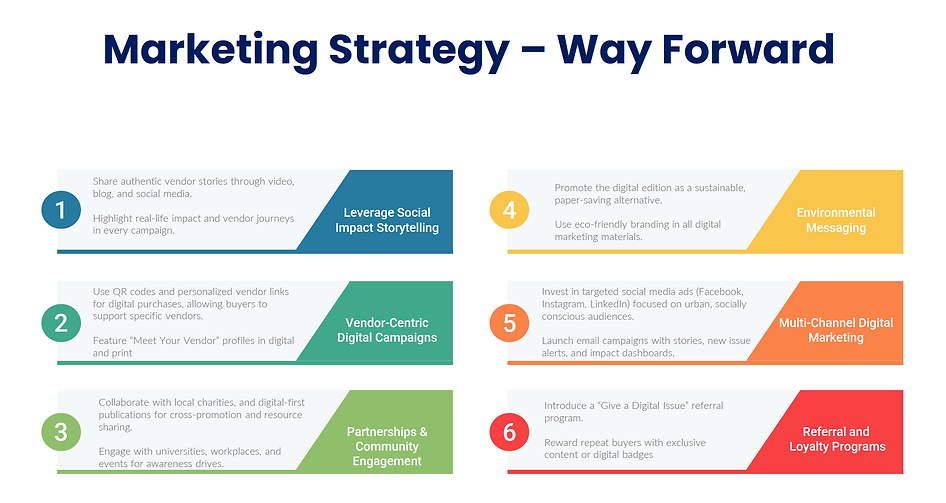
Enable vendor-linked digital purchases: Each vendor has a unique QR code or URL, so buyers can scan, pay instantly with mobile wallets, and know that vendor gets credited in real time.
-
Ensure transparent vendor earnings: Clearly state, at every digital touchpoint, what portion of each digital sale goes to the vendor, with impact dashboards if possible.
-
Mobile-optimized digital magazine: No app required—responsive web page editions with accessibility options and minimal friction.
-
Boost awareness and education: Campaigns on public transport, in social media, and street signage explaining The Big Issue’s mission, digital options, and how anyone can support a vendor—even in a hurry or without cash.
-
Further research: Recommend iterative testing with a larger, more diverse sample (including more vendors), continuous refinement of digital payment flows, and ongoing usability evaluation as features are developed.
This approach centers vendor empowerment, user trust, social impact, and frictionless digital convenience—positioning The Big Issue for sustainable, scalable impact in the digital era.